Joining Materials: Traditional Joinery and Modern Fasteners in Repair and Making
Why joining choices matter
How materials are joined determines not only initial strength but the path of future repairs. Traditional joints and modern fasteners each shape a work’s life differently. This note compares these approaches in terms of assembly, repairability, and the relationship they create between maker, object, and future maintenance.
Traditional joints: geometry and continuity
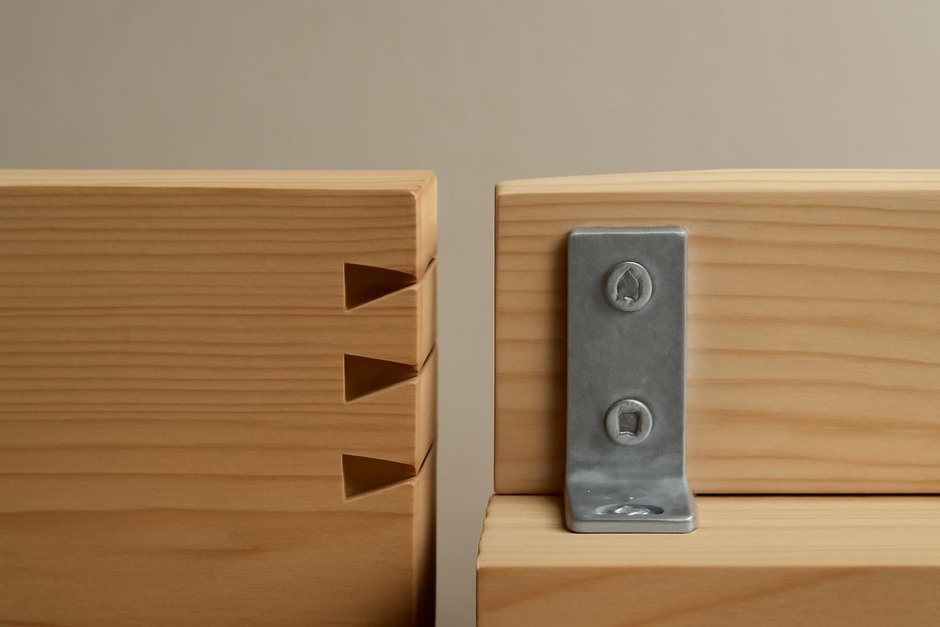
Mortise and tenon, dovetails, and lap joints distribute loads across mechanical forms of the wood itself. They often require more time and layout skill but yield connections that can be tightened and sometimes reworked by removing wedges, trimming, or re-gluing. The continuity of material across a joint can simplify long-term repair because the structure is read as a whole rather than as an assembly of parts.
Mechanical fasteners: speed and accessibility
Screws, bolts, and brackets allow quick assembly and straightforward disassembly. They are practical when speed, adjustability, or retrofit options are important. Modern fasteners can be tightened, replaced, or upgraded without skilled reshaping of the components. Their visibility can be minimized with countersinking and caps, but they nonetheless create discrete interfaces that can be addressed independently of the base material.
Tool demands and skills
Traditional joinery rewards marking and cutting skills, dedicated hand tools, or jigs that reproduce forms precisely. Fasteners require drills, drivers, and an understanding of load distribution. Both sets of skills are learnable; the choice often reflects whether a maker values a slower assembly with a continuity of material, or a modular approach that anticipates future access and replacement.
Repair strategies
Repair differs. Traditional joints can sometimes be eased apart and re-fitted, or reinforced with splines and wedges. But when a timber splits across a joint, repair can be complex. Fasteners make targeted replacement straightforward: a damaged member can be removed without wholesale disassembly. Bolted connections, for example, allow parts to be removed and new parts fitted without altering the rest of the work.
Hybrid approaches
Many makers use hybrids: a mortise and tenon reinforced with a bolt, or dovetails for drawer fronts combined with screws for case backs. This approach leverages the strengths of both systems. The traditional joint provides primary alignment and a sense of continuity, while the mechanical fastener supports serviceability and periodic replacement of high-wear components.
Choosing for context
Consider the object’s intended use, anticipated maintenance, and who will perform repairs. Domestic furniture that may be moved or altered benefits from accessible fasteners. Heirloom pieces intended for longevity might favour dovetails and through-tenons that can be reworked by a skilled craftsman. For conservational practice, less intrusive mechanical interventions can sometimes preserve original material better than invasive traditional repairs.
Joining choices reflect values as much as function. Observing how a variety of approaches age in a given environment helps refine a maker’s sense of which connections will serve both present needs and future care.