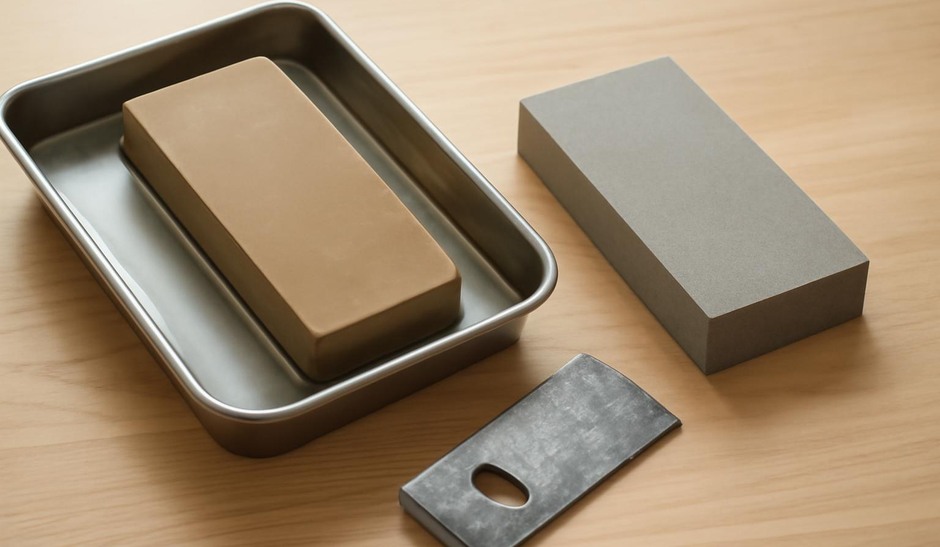
Sharpening Stones: Waterstones and Arkansas Stones in the Studio
Stones in the workflow
Sharpening stones shape the edge and the experience of maintaining tools. Waterstones and Arkansas stones behave differently under hand and influence how often you sharpen, how you feel the edge develop, and what final polish you achieve. Below are observations from shops where both types are used regularly.
Surface and lubrication
Waterstones usually require soaking or frequent wetting and develop a thin slurry that aids cutting. The slurry behaves like a light abrasive paste that can speed steel removal and improve polish. Arkansas stones, an oilstone family, are naturally harder and often used with light oil or dry, producing a direct, tactile engagement with the steel. The decision to use oil changes cleanup routines and studio habits.
Feedback and stroke feel
Waterstones, because they abrade faster, offer rapid feedback. You can see edge progression in a few strokes as the slurry forms and the burr appears. This is useful when setting a bevel or reshaping. Arkansas stones provide a slower, steadier feel that many describe as more controlled for final polishing. The slower cut invites patience and an attention to pressure and angle over a longer stroke count.
Grit progression and flattening
Both systems need grit progression from coarse to fine. Waterstones typically come in a wider range of grits that remove steel quickly on coarse sizes and finish to high polish with finer grits. Arkansas stones are valued for their uniform particle distribution and can produce a fine edge particularly on higher-grade stones, but coarse Arkansas varieties remove material slowly. Waterstones are softer and therefore require more frequent flattening, which is a small ongoing task in the studio. Arkansas stones hold their flatness longer.
Practical studio routines
A common routine pairs a coarse waterstone for initial shaping with a hard Arkansas stone for refining and polishing. The waterstone reshapes quickly; the Arkansas stone brings a dense, durable mirror finish. Many makers keep a flattening plate nearby to maintain waterstones and a small container of oil for Arkansas stones. Some prefer an all-water workflow to avoid oil entirely; others accept oil for the tactile result it helps produce.
Safety and waste
Waterstone slurry is easy to rinse away; dry particles are less dusty than some other abrasives but still merit sensible cleanup. Oilstones require oil management and careful disposal of rags. Both approaches benefit from a dedicated sharpening station to contain mess and to establish repeatable posture and angle control.
Choosing what fits your practice
Waterstones reward frequent resharpening and fast reshaping; they suit busy shops where edges are refreshed often. Arkansas stones reward a measured approach and excel as a final step for a keen, durable polish. The two types work well together: rapid shaping on waterstones followed by finishing on an Arkansas stone yields a reliable edge and helps distribute maintenance tasks across short sessions and longer, more focused finishing passes.
Try simple projects with both systems to discover which feedback and rhythm fits your habits. The right routine is the one that sits comfortably in your studio life and keeps tools ready to make without becoming a chore.