Pigments: Natural Grounds and Synthetic Dyes for Sketchbook Washes
Materials and their voices
Sketchbook washes are intimate marks. The choice between natural ground pigments and synthetic dyes affects color behavior, staining, and long-term change. The following observations highlight practical differences that matter to makers who carry a sketchbook daily.
Mixing and particle behavior
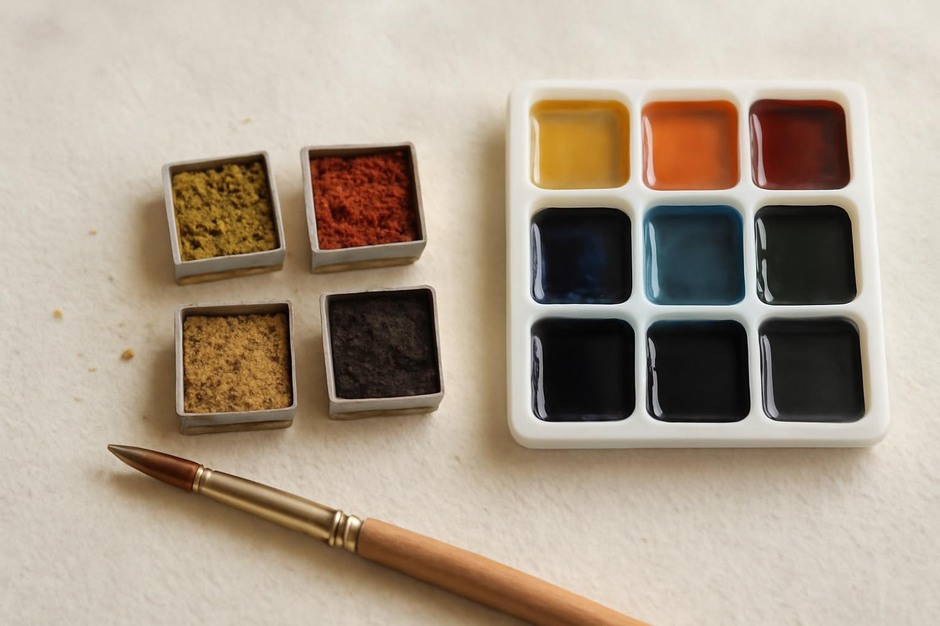
Natural ground pigments are mineral or organic particles suspended in a medium. Their particle size and surface chemistry influence texture and opacity. They can sit on paper with granulation, leaving a tactile surface that reads as material. Synthetic dyes dissolve and color the wet medium uniformly, creating flat, transparent washes that sink into paper fibers more evenly.
Staining and lifting
Dyes tend to stain paper and resist lifting once dry. This makes them excellent for strong, saturated passages but less forgiving when you want to lift highlights. Pigmented washes, depending on binder choice and pigment particle size, can be lifted with care, especially early in drying. For makers who like to rework surfaces, pigment-heavy mixes offer more room for selective erasure and scraping.
Lightfastness and permanence
Lightfastness varies widely. Some historical pigments are remarkably stable; others fade with exposure. Synthetic dyes include both fugitive and more permanent formulations. For sketchbooks intended as working documents rather than archival objects, the decision centers on the intended lifespan. If permanence is a concern, consult pigment labels, test patches, and consider storing sketchbooks away from intense light to reduce change over time.
Color mixing and layering
Pigments often layer in ways that reveal texture: granulation and sedimentation contribute to complex surfaces. Dyes layer cleanly and build through transparency. When mixing, dyes can achieve vivid colors at low concentrations, while pigments may require more binder or repeated layers to reach similar intensity. Both approaches can be used together: a dye base for luminous color, with pigmented accents to introduce texture.
Handling and studio care
Natural pigments often arrive as powders requiring careful handling to avoid inhalation and dust. They need a medium to bind them for wash use. Dyes are usually soluble and convenient in compact tins or tubes. In a travel sketchbook practice, dyes offer lighter, faster setups; pigments are rewarding for studio sessions where cleanup and ventilation are available.
Expressive choices
The expressive decision is not only technical. Natural pigments connect to place and material history; their granulation and surface presence can feel allied to the tactile world makers observe. Dyes provide immediacy, flat luminosity, and fluid blending that suits quick studies and layered color fields. Each choice supports different habits of seeing and recording.
Experimentation in small swatches clarifies how specific colors behave on your preferred papers. Keep simple notes about binder ratios, paper texture, and drying times. Over time you will learn which washes resist repair, which lift well, and how to combine materials to achieve the visual language you seek in a sketchbook practice.